
Measure & Track Transition Readiness
PSTRS
Positive School Transition Readiness System
PSTRS IS THE FIRST RESEARCH-INFORMED PLATFORM TO MEASURE & TRACK TRANSITION READINESS.
It helps schools worldwide to identify factors that predict adolescent wellbeing and successful school transitions. Strengthening these factors increases the likelihood that students experience both wellbeing and successful transitions.
Schools can now apply for early access.
Estimate Your School's Transition Risk Cost
Enter your total number of students and the average annual tuition.
*Students in upper primary, middle, or lower high grades (e.g., Grades 5–9).
Based on a 10% transition difficulty benchmark. This estimate reflects tuition exposure associated with student transition difficulty. Additional costs related to transition difficulty — such as staff time, behavioural support, intervention, or staff turnover — are not included.
For less than 1% of projected tuition risk, PSTRS gives schools predictive insight into student wellbeing and transition readiness.
The Institutional Problem
They Need More Than Academics
Helping young people flourish requires looking beyond grades.
Academic performance is only one part of the story, particularly during early adolescence, when students face rapid neurological, social, and developmental changes.
School transitions often occur during the same period as puberty, placing additional demands on students.
The Critical Window for Prevention
Research consistently shows that late childhood and early adolescence represent a critical window for preventative wellbeing strategies [8].
• Many mental health conditions begin during adolescence, with a substantial proportion emerging before age 14 [2].
• Globally, it is estimated that over 20% of children and adolescents experience mental health challenges [3].
• 1 in 7 adolescents (10–19 years) globally experience a mental disorder [1].
Because this developmental period often coincides with puberty, academic changes, and school transitions, it represents a particularly sensitive “make-or-break” window for preventative wellbeing strategies.
The Global Reality
• Youth mental health has worsened significantly globally over the past decade, with mental illbeing now highest among adolescents [7].
• Recent research shows that the rise in youth mental health difficulties is particularly pronounced among girls [7].
• Suicide is among the leading causes of death among young people globally [1].
The Unsuccessful Transition Gap
• Educational transition research shows that many students experience difficult adjustment when moving to a new school environment [4].
• Around 40% of students struggle to make expected academic and social progress during the transition to secondary school and over 20% experience a negative school transition [4].
• Even in high-performing systems with dropout rates as low as 11%, many students report declines in academic engagement and confidence as well as feeling unhappy or disengaged during transitions [4].
The Hidden Risk of School Transitions
• Adjustment Gap: A substantial minority of students struggle to adapt to new academic and social environments [4,8].
• Transition Dip: Many students experience a temporary decline in wellbeing, belonging, or academic performance during transitions [4,8]
• Resilience Minority: Only a small proportion maintain consistently high wellbeing without additional support [8]
• Intervention Need: Some students experience persistent declines requiring targeted support [8]
Because transitions coincide with puberty and affect nearly all students in some way, active monitoring of wellbeing predictors across the entire cohort is essential to ensure no student falls through the cracks.
The High Cost of Disengagement in Canada
• Secondary school dropout rates in Canada generally range between 7% and 13% [5]
• Canada has one of the higher youth suicide rates among high-income countries [6]
• Children’s life satisfaction in Canada has declined in recent international wellbeing comparisons [6]
Financial Costs and Institutional Risk
When transition readiness gaps go undetected, schools often experience:
• Projected attrition risk
• Increased behavioral and pastoral load
• Staff burnout and turnover
• Withdrawal and disengagement
• Institutional resilience deficits
The Lead Indicator
Students reporting high levels of positive factors such as school belonging are significantly less likely to experience declines in engagement and academic outcomes [3,8].
They are also more likely to experience positive transitions and overall wellbeing throughout adolescence.
Sources
[1] https://www.who.int/news-room/fact-sheets/detail/adolescent-mental-health
[2] https://jamanetwork.com/journals/jamapsychiatry/fullarticle/208678
[3] https://www.oecd.org/pisa/innovation/student-well-being/
[4] https://bera-journals.onlinelibrary.wiley.com/doi/10.1002/rev3.3444#:~:text=It%20is%20important%20to%20note,major%20gap%20in%20the%20literature.
[5] https://www150.statcan.gc.ca/n1/daily-quotidien/101103/dq101103a-eng.htm
[6] https://www.unicef.ca/en/rc19
[7]https://pmc.ncbi.nlm.nih.gov/articles/PMC12385385/https://www.nber.org/papers/w31293
[8] https://www.tandfonline.com/doi/full/10.1080/21683603.2019.1572552
What Makes PSTRS Different
Move beyond outcomes alone. A research-based platform that measures transition readiness and the factors that predict student wellbeing and success — so schools can identify who may need support and where to focus.
Our platform stands out for its:
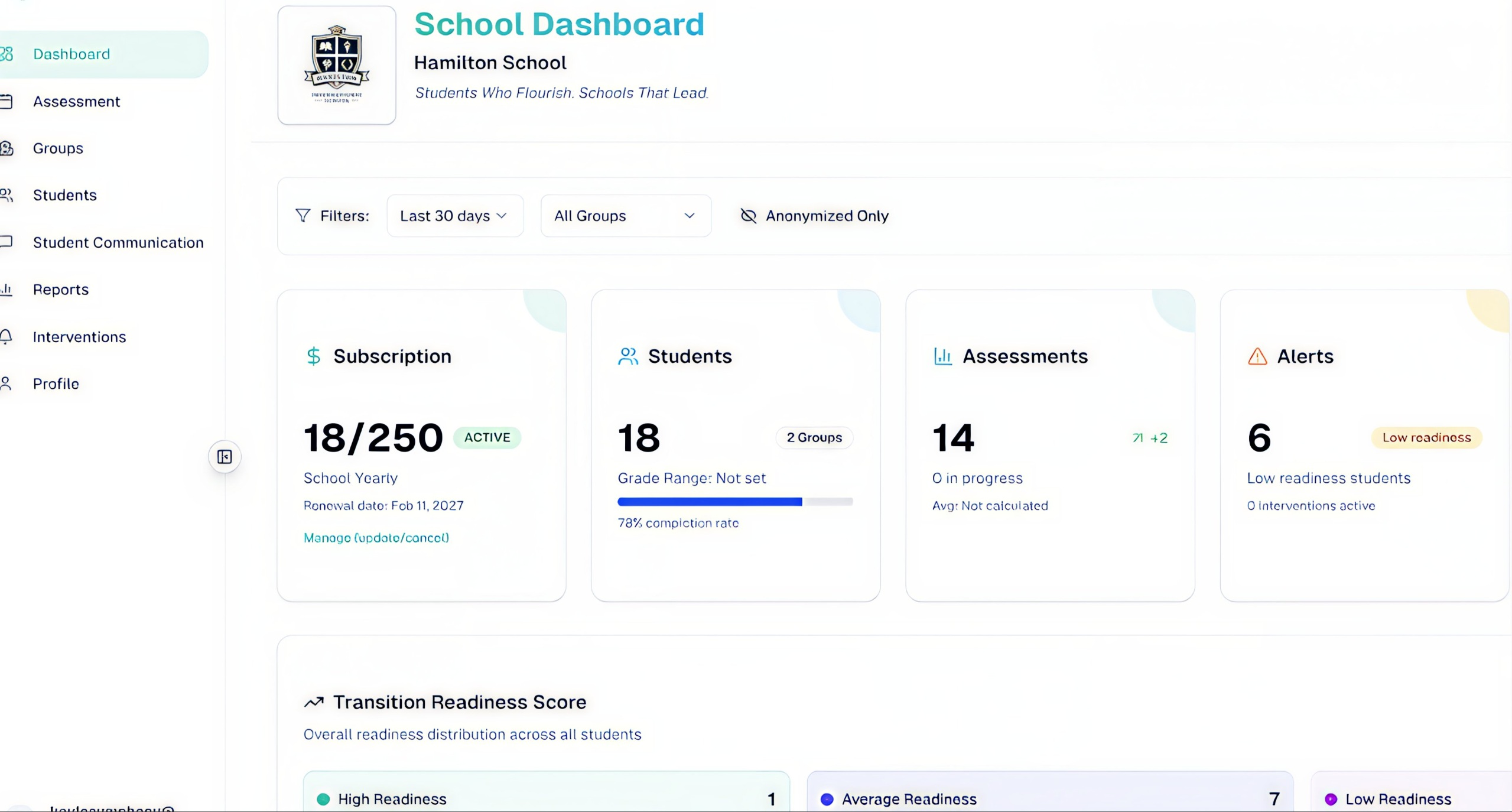
• Broad scope: Measures 20 separate components across physical, social, spiritual, psychological, and school readiness, providing a comprehensive overview.
• Scientific reliability and validity: Developed and validated through scientific research, ensuring accuracy and trustworthiness of results.
• Immediate insights: Instant digital scoring and reporting provide clear insights into areas of strength and those needing attention.
• Expert-designed platform: Developed with expertise in school psychology, positive psychology, and adolescent wellbeing to ensure scientifically grounded insights and practical recommendations.
• Rule-based recommendations: Recommendations for schools and students, including gender-specific recommendations.
• Student-informed insights: Informed by early adolescents’ own perspectives on the factors that influence their wellbeing.
• Ease of use: User-friendly design enabling efficient administration and clear reporting.
• Cost-effectiveness: At an accessible price point, schools gain structured insights into the factors that predict adolescent wellbeing and successful school transitions.
Why This Matters to Schools
Knowing which areas are strong or weak aids understanding of a student’s overall readiness for school transition, empowering school leaders and educators to make informed decisions.
Early identification enables timely and informed intervention planning. Schools can:
• Track changes in transition readiness over time
• Evaluate program effectiveness using observed changes in scores
• Monitor key predictors of adolescent wellbeing
• Strengthen support allocation before problems escalate
Generate cost savings and return on investment, as early identification and prevention reduce the much higher costs associated with unmanaged transition difficulties.
Why Join the PSTRS Early Access?
• 50% Institutional Pricing — Preferential early access rate before public launch
• Full Platform Access — Survey administration, dashboard analytics, student and school-level reporting, rule-based recommendations, transition readiness tracking, and structured intervention planning tools
• Implementation Guidance — Direct onboarding support during rollout
• Influence Final Development — Your feedback refines reporting and features
• Early Partner Recognition — Early partner acknowledgement